The Church of Gesu At The Ateneo
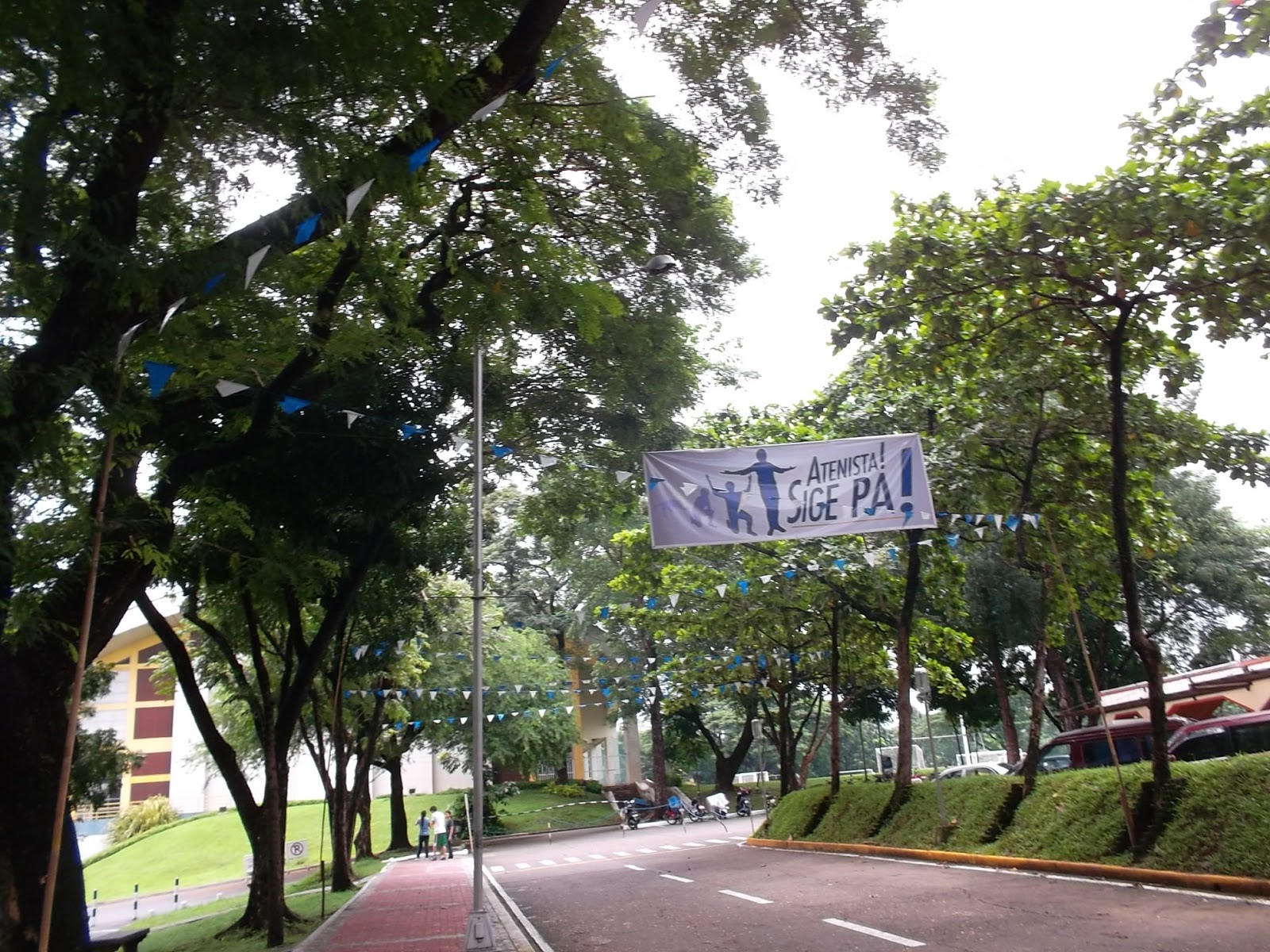
The native bamboos sway a little bit as a gush of wind is felt in my direction. Not unusual on a summer day. I take a narrow brick path leading to a short bridge that opens to a reserve planted to a variety of trees and ornamental plants. I find myself near a cluster of halls in an area considered as the highest point of what is dubbed as Loyola Heights. Residence Halls, which include Cervini Hall, Eliazo Hall and the University Dormitory, are indicated on a tin signage hanging at a post. I decide to take another path that leads me back to the main road. From here, I can see a white-painted structure with a cross visible even from afar. It is the Church of Gesu located right inside the wide Ateneo De Manila Campus at Loyola Heights in Quezon City.
 |
| Resilient bamboos and other plants still thrive inside the Ateneo campus in Loyola Heights. |
 |
| A short, narrow bridge leading to the dormitories. Students still use this as a short cut to the other buildings in the area. |
 |
| A brick walkway leading to the Residence Halls |
 |
| Residence Halls include Cervini Hall, Eliazo Hall and the University Dorm. |
 |
| The main road that connects the Grade School zone to the College and High School areas and other institutes of learning. Ateneo has adopted the one-way traffic scheme within the 83-hectare campus to ease traffic during peak hours. |
 |
| The Church of Gesu stands at an area considered as the highest point within the vast Ateneo campus. The church and the gardens surrounding it cover approximately one hectare of prime land. |
With a triangular shape that covers an area of about one hectare, the Church of Gesu symbolically represents the Holy Trinity, that is, the three persons in one God concept. The extraordinary design makes it an eye catcher. As one drives through the main road from Gate 3, the Church of Gesu is at the eastern end of the road. A statue of the Sacred Heart stands right in front. A little bit to the right is the bell tower. The church is open on all sides except the eastern section where the main altar is located.
 |
| The cross can be seen as far as Katipunan Avenue. |
.JPG) |
| The Church of Gesu facing west |
.JPG) |
| The statue of the Sacred Heart in front of the church. The hill where it stands is also called Sacred Heart Hill. |
.JPG) |
| Matthew 11:28 |
 |
| The church is open to everybody. |
 |
| Main entrance of church. |
 |
| Artistically designed |
 |
| Front area of the church and the numerous trees surrounding the church. |
 |
| Main entrance at the western side as viewed from inside the church. Across is Bellarmine Field. |
 |
| The bell tower at the right side of the church. It has a set of bells that play beautiful music at designated hours. Bells are also rung as reminders to the faithful of significant events. |
 |
| The construction of the bell tower and the installation of the mechanism of the Carillon are special projects of Class 56/60/64 as indicated in this bronze plaque. Class members call themselves The Bell Ringers of Gesu. |
The Church of Gesu is the mother church of the Society of Jesus, a congregation which has been administratively running the premier school since its establishment in 1859. Aside from the unusual shape of the church structure, a main attraction is the big cross that hangs atop the main altar. It is a figure of Christ still suffering on the cross and gazing towards heaven. As one enters through the western side, which is the main entrance, a big rock with water gently flowing down serves as the church stoup where one dips his fingers and makes the sign of the cross. Serving as background are stained glasses depicting the passion and death of Christ. A great part of the ceiling is made in such a way that the skies can be seen from inside the church.
 |
| Water gently flows down this big rock serving as stoup where churchgoers dip their fingers and make the sign of the cross. |
 |
| Church interior |
 |
| Church's high ceiling |
 |
| The main altar |
 |
| The Crucified Christ is shown looking upwards, talking to His Father. |
 |
| Wooden statues of Christ |
 |
| Natural light is allowed inside the church through a specially-designed ceiling. |
 |
| The northern side ceiling of church |
 |
| The center aisle as viewed from the main altar |
 |
| A wooden station of the cross |
There is enough time to say a short prayer. I continue taking shots and continue asking questions whenever I see a guard or a utility man. I look at my camera. A red light is flashing, indicating that battery power is getting weak. Not now, not here, please. I cross the main road where huge acacia trees abound and walk through the open space of Bellarmine Field. Ateneo campus still has that verdant green and is orderly and conducive to learning. I look again at the Church of Gesu. It is really awesome. It is perhaps Ateneo's most beautiful landmark.
- Konted
 |
| The Bellarmine Field as seen from the western side of the church. Bellarmine Field is where students gather in celebration of significant court victories in the UAAP. |
 |
| The triangular shape of the church is highlighted. |
 |
| A garden at the northern side of the church |
 |
| It depicts the Agony in the Garden. |
 |
| Northern side entrance of the church |
 |
| Strict silence is observed. |
 |
| Walkway leading to nearby buildings. |
 |
| View of Church of Gesu from the western end of Bellarmine Field. |
______________________________________________________

.jpg)