Showing posts with label jose rizal. Show all posts

Monday, 17 March 2014

Paco Park: Enchantingly Beautiful


Paco Park:  Enchantingly Beautiful

          Amidst the tempered celebration last Sunday, with colorful butterflies fluttering upwards and some pigeons making their way to the tree tops, the newly wed couple stepped out of the ancient chantry, smiling and waving at well-wishers. 

          It was a romantic wedding solemnized at the St. Pancratius Chapel located within the historic Paco Park. I was there as a kibitzer.


Paco Park has been declared as a National Historical Shrine.  It is located at the corner of Padre Faura St. and San Marcelino St. in Manila. This is the main gate and the outer wall.

This is the 2nd or inner gate.  Pigeons perch on the ledges  of the arch.

The secondary or inner wall of Paco Park

The paved walkway between the outer wall and the inner wall.

There are old style lamp posts throughout the park.

          Paco Park is one of the oldest parks in Metro Manila. It started as a municipal cemetery during the Spanish regime.  The wealthy Spaniards used to bury their dead at what was then known as Paco Cemetery. 

          The oval-shaped park, which stands within a relatively vast tract of prime land, has niches constructed within the walls.  There are actually two walls: the inner wall and the outer wall. 

The view as you enter the 2nd gate.

Some members of a wedding entourage get ready for the next mass .

The St. Pancratius Chapel located inside the park.  When the water fountain is activated, you surely will have picture-perfect shots.

Paco Park is one of the most popular wedding venues in Metro Manila.


An old bell hangs near the chapel's vault.  The chapel is now air-conditioned.

Schedule of masses at the St. Pancratius Chapel. It is under the supervision of San Vicente de Paul Parish.

The chapel's interior.

Quaintness is the chapel's major description.

Concrete stairs leading to the elevated walkway

This one leads to the outer wall.

           When Jose Rizal died by firing squad in Bagumbayan on December 30, 1896, his body was secretly taken to Paco Park where it was buried with a cross placed on top of the mound. His initials in reverse, RPJ, served as marker.  Authorities wanted to keep it a secret as they feared his death would create a martyr-worship cult. 

             Fathers Gomez, Burgos and Zamora, better known as Gomburza, who were executed in 1872, were also interrred at the Paco Park and Cemetery. Interment stopped in 1912.

Dr. Jose Rizal

Execution of Jose Rizal in 1896 at Bagumbayan

The original grave of national hero Jose Rizal. He was reportedly buried without a coffin.

It took several days for the siblings of the national hero to find the body of the fallen Rizal. In 1912, the remains of Rizal were transferred to Luneta Park.

As inscribed here, Jose Rizal died a mason.

Two die-hard Rizalistas visit the grave of their idol.  They refer to him as "Ka Pepe".

The park is circular in shape.

One of the very few niches that can still be seen at Paco Park. This one was interred in 1907.

Most of the niches at Paco Park are empty as the remains were transferred elsewhere when the place stopped operating as a cemetery in the early 1900's.

The remains of  the three priests known collectively as Gomburza, and who died as martyrs, are interred at Paco Park.

More about Gomburza


            As the wedding car moved out of Paco Park, I sat on a bench and gazed around. A huge acacia tree stood proud near St. Pancratius Chapel.  

           With stillness pervading throughout the park, my mind wandered to that summer day in 1975, when Father was driving and I was his lone passenger. We were heading towards Paco Park.  It was five thirty in the morning. I could still hear his voice: "The Governor is already there.  The Commanding General of the Philippine Army flew all the way from Dadiangas. Don't keep them waiting."  

             It was my wedding day. It was set at 6 am. If Rizal was sentenced to die by firing squad and later buried at Paco Park, I, too, was given a sentence on that fateful summer day.  It was like I was sentenced to Reclusion Perpetua. I was chained to somebody for the rest of my life. I lost my freedom at Paco Park.

- Konted

Picture-taking  at Paco Park after the wedding. Old photo above was taken some 39 years ago. Wedding gown was by top fashion designer Cesar Gaupo.

Tropicana Studio did the photo shoot.

Most of the pictures were in black and white.  Some were colored. They are now fading.

Old photo of bride

A summer wedding

Guests Renz Salomon, Bob Soliongco, Rouel Quito and Mr. and Mrs. Rafael Quito.  Rouel and Bob were secondary sponsors.

_____________________________________________


Sunday, 29 December 2013

Jose Rizal's Last Moments


1880 photo of Fort Santiago
Jose Rizal's Last Moments

          It was too quiet then at a cell in Fort Santiago. Only the steps of the Guardia Civil could be heard as they reverberated off the brick walls. Jose Rizal, imprisoned for rebellion, sedition and conspiracy, was to be executed the next day. After a few minutes, more steps could be heard. Rizal's mother and his sisters made their last visit.

Rizal's cell at Fort Santiago
Sisters of Jose Rizal

          As sister Trinidad got near, Rizal whispered something. There were no CCTVs then.Trinidad was listening intently. She got the message: that there was a paper neatly tucked in the Cocinilla and she was to retrieve this once the family would gain possession of it. What it contained, nobody else knew.  Not even an inkling. 
 
Dr. Jose P. Rizal

Original cover of Noli Me Tangere

          For writing two novels, El Filibusterismo and Noli Me Tangere, which opened the eyes of his countrymen to the colonizers' excesses and abuses, Rizal was considered as a threat to the State.  He was beginning to show signs of being an effective national leader, and for this, the Spanish authorities felt uncomfortable.  He was seen as a beacon by his compatriots, providing light after years of darkness.

Sketch of Leonor Rivera done by Jose Rizal

Josephine Bracken

           As a writer, sculptor, physician, artist, athlete, orator, Rizal valued excellence and dedication. He was consistently showing flashes of brilliance. If Rizal was good in writing, then one can surmise that he made good use of this when pursuing beautiful women like Leonor Rivera, Segunda Katigbak, O Sei San and Josephine Bracken.  There were no cellphones, facebook, twitter, etc, then. One had to get hold of a fountain pen and express his sentiments. And no one could do it better than the man from Calamba.

Rizal's execution on Dec 30, 1896 at Bagumbayan

           Execution day finally came. From his cell, on December 30, 1896, he was taken by his guards to Bagumbayan.  Men, armed with rifles, aimed and fired.  He fell face down. It was all over in a few minutes. Rizal's body was taken and dumped at a public cemetery which we now call as Paco Park. Without a coffin, a marker was placed on top of the mound with his initials reversed: RPJ. 

Rizal's original grave at Paco Park

            As agreed upon, Trinidad retrieved a piece of paper from the Cocinilla. It was a letter from Jose Rizal, obviously written a few days before his execution. It was actually a poem.  It had no title, no date and no signature.  Here is Jose Rizal's last masterpiece as translated by one Dr. Barron. This poem, together with his death by firing squad, changed the course of Philippine history.

(no title)

Land that I love, farewell.
I shall die as the east grows red,
If the dawn lacks color, I shall make it glow,
I shall paint the day with my blood.

Would that my country were free from pain!
How good to die that you might live,
To fall if you could rise,
And sleep forever under your skies!

May some flower bloom where my body lies!
Kiss it; you kiss my soul.
I shall feel the touch of your lips in my tomb,
Be warmed by your breath as by a flame.

Let the moon watch over me, pure and serene
When the dawn comes, let the wind softly complain,
If a bird lights on the cross, let it sing its song.
Let the sun shine, the rain come, a friend mourn.

Pray for me and all the fallen;
Pray for the mothers whose children go hungry,
Pray for widows, orphans, prisoners under torture,
Pray for all the living who are in pain.

When night comes and my grave in darkness lies,
Break not the peace, kneel before the mystery,
If you hear the sound of music, be not afraid.
It is I.

When my death is forgotten, my grave unmarked,
Let the plow turn the earth where I lie.
May my dust make fertile the fields!
Where the grass grows thickly, there I dwell.

In the air, over the hills and valleys of the land,
I shall linger – like a ghost, a whisper, a sigh,
A fragrance, splash of color, shaft of light.
In this faith I shall go to die.

Land that I love, whose grief is my own,
Goodbye! Father, mother, all my affections,
I go where there are no slaves, no oppressors.
I go where faith does not kill.

Farewell to all I love, peace has been waiting long.
Farewell, sweet foreigner, my true love, my delight.
All that I cherish, farewell –dear earth, dear life.
I die. I shall rest. It is well.

Free Translation by Dr. Barron

* I  came across this translation in the late 80s while reading Mabuhay, a Philippine Air Lines magazine.

*All pics from Google

-Konted


Thursday, 4 July 2013

The Oblation At The University Of The Philippines


The Oblation At The University Of The Philippines

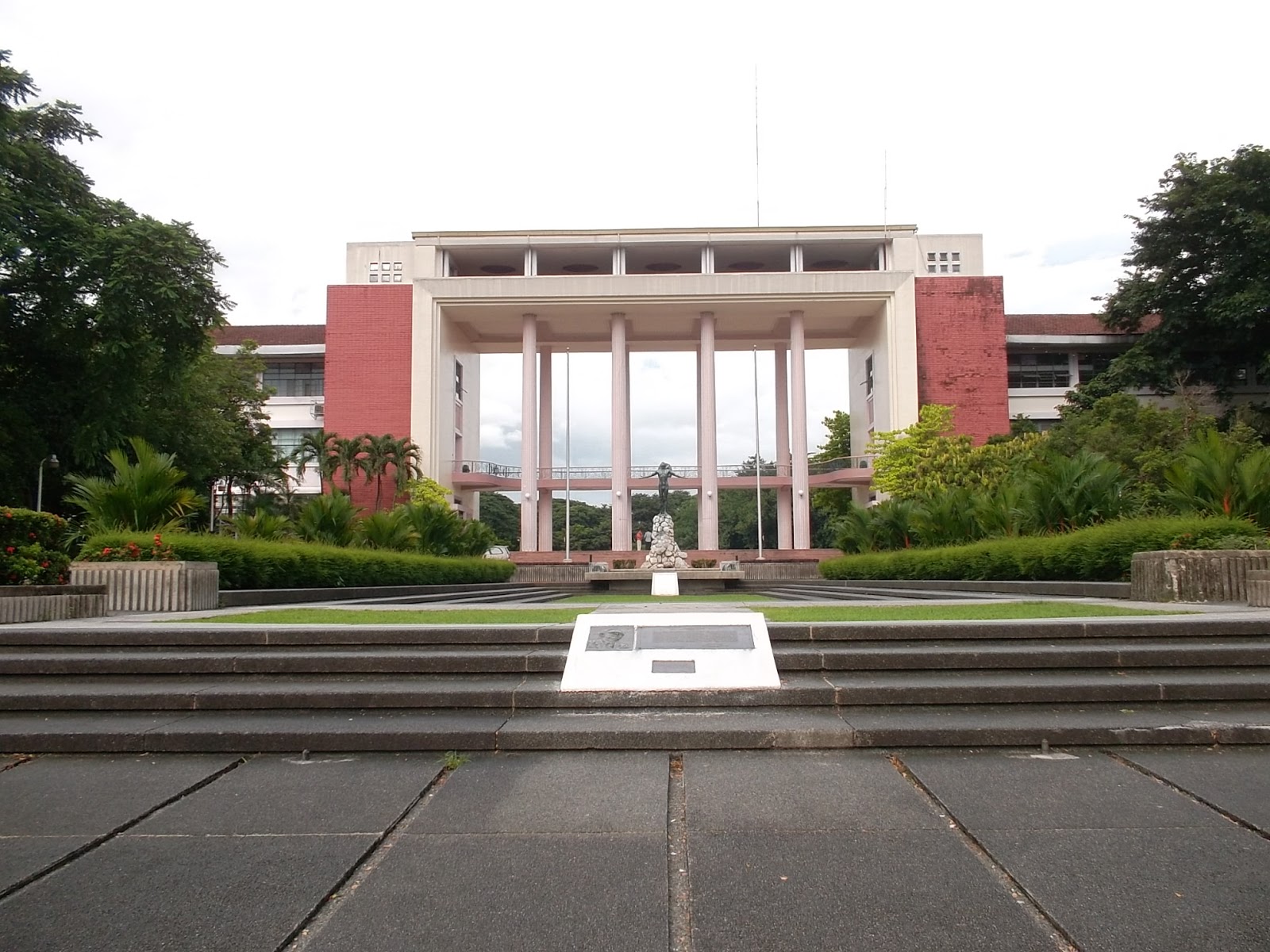
               If De La Salle University is closely identified with the Green Archer figure and the Ateneo De Manila is represented by a Blue Eagle, the state-run University of the Philippines has the statue of The Oblation as its iconic symbol.  When one thinks of UP, what comes to mind is The Oblation.  When one thinks of The Oblation, UP springs to mind. They have become interchangeable.

              As one enters the University campus through its western gate, the concrete statue of The Oblation, erected in front of an elevated building, looms on the horizon. It is, undoubtedly, the biggest single attraction inside the university campus.  With several utility personnel assigned to it, it is well maintained.

              With a figure of a man in his naked glory, with outstretched arms and head tilted towards the sky, The Oblation symbolizes the university's noble objectives and represents the model student's idealism of offering himself in the service of the country. Being naked symbolizes the purest of intentions. The "nothing to hide" notion is also depicted here.

               Done by sculptor Guillermo Tolentino as commissioned by University President Rafael Palma in the 1930s, The Oblation was actually inspired by Jose Rizal's My Last Farewell, particularly a stanza which goes like this:  

" On the field of battle, 'mid the frenzy of fight,
Others have given their lives, without doubt or heed,
The place matters not - cypress, or laurel or lily white,
Scaffold or open plain, combat or martyrdom's plight,
T'is ever the same, to serve our home and country's need. "
                              Translated by Charles Derbyshire

              The Oblation has also inspired members of the Alpha Phi Omega (APO) to stage the Oblation Run every year where they run naked around the Diliman campus.  It is also their way of expressing their sentiments concerning burning issues of the day. It is a much-awaited campus activity.

              Our neighbor here apparently has also been inspired by The Oblation.  Every year, on his birthday, Tamboy engages his friends in a drinking bout.  After downing bottles of Ginebra San Miguel, he would streak naked through the main road and side streets while shouting invectives.  Tamboy was not lucky this year.  He was arrested by the police, charged with public scandal and spent some time in jail.  Upon his release, his wife was heard reprimanding him: " Pambihira ka. Hindi ka na nahiya sa mga tao.  Sabagay, wala naman yan."

 - Konted

The Oblation at the University of the Philippines in Diliman, Quezon City


About The Oblation.  Oblation means sacrifice or offering


The trimmed garden in front of The Oblation


About the University of the Philippines


Closer shot of the statue of The Oblation.  The rocks used as base were taken from the Montalban river.


2nd stanza of Jose Rizal's Mi Ultimo Adios which inspired the construction and design of The Oblation


A Quotation from Jose Rizal's El Filibusterismo placed near the statue.


Picture of The Oblation with the photographer facing west.


Closer shot. This is actually a replica.  The original one is kept at the Main Library.


Quezon Hall


Acknowledgement of the support extended by the US gov't in the establishment of UP


The amphitheater behind Quezon Hall


The Carillon Tower as viewed from The Oblation.  It is playing beautiful music again.


Nice Philippine tree near the driveway of Quezon Hall


The main road near The Oblation


New traffic scheme inside UP Campus


The Jorge B. Vargas Museum along Laurel Ave inside the UP Campus.  It houses the personal collection of works of art and other memorabilia of the former Presiding Officer of the Philippine Executive Commission.  Vargas also served as Secretary of National Defense and as Mayor of Manila..


Main Building of the College of Arts and Letters along Laurel Avenue


Bulwagang Rizal is one the three buildings within the College of Arts and Letters. It is also known as  The Faculty Center.


The Palma Hall was built by architect Cesar Concio and named after UP President Rafael Palma. It is also knowns as AS Building.  AS means Arts And Sciences. The Oblation Run starts here.
Oblation Run staged by the Alpha Phi Omega Fraternity (G'gle file)
Laurel Avenue


The Center for International Studies is housed at Benton Hall.


Visit Benton Hall and know more about Sexual Harassment.


Benitez Hall houses the College of Education


The football field inside the UP Campus


An afternoon activity


Photo of Benitez Hall taken from the football field


Wide walkway lined with trees


The College of Business Administration has been renamed as Cesar Virata School of Business.
Osmeña Avenue

Melchor Hall along Osmena Avenue is the Main Building of the College of Engineering. It was named after Alejandro Melchor, Sr.  who was Secretary of National Defense during President Quezon's time.  He was an engineer and a brilliant mathematician.


Church of the Holy Sacrifice, formerly known as the UP Chapel. It was designed by architect Leandro Locsin.


Francis Pacheco's favorite Bird of Paradise near the eastern gate of the Church


The Ten Commandments


About the UP Church


Church's interior


Closer shot of main altar


A Station of the Cross painted by National Artist Vicente Manansala


Garden of Justice and Peace within the Church's compound


Garden of Mother and Healing


At the rear portion of the Church


So that the faithful may know


Schedule of activities


Across the UP Church


The University Hotel is operated by UP's Board of Overseers.  It  was known then as  the PCED Hostel.  It is located near the UP Church.
Built in 1992, Ang Bahay ng Alumni serves as a convention center.  It is along Magsaysay Avenue.

The Center for Women's Studies is focused on the equality of men and women before the law and on the role of women in nation building.  It is located along Magsaysay Avenue.

Cine Adarna is the main theater at the UP Film Center located along  Magsaysay Avenue.

The International  Center dormitory along Guerrero St.

The Romulo Hall at the corner of Magsaysay Avenue and Guerrero St. houses the Asian Center and Institute of Islamic Studies.

The UP Law Center at Bocobo Hall along Magsaysay Avenue.
Osmena Avenue side of Bocobo Hall


The Sunken Garden as viewed from Osmena Avenue

Sampaguita Residence  Hall serves as dormitory for female upperclassmen.  It is located along Quirino Avenue.

Llamas Science Hall

The Natural Sciences Research Institute is housed at the Miranda Hall located at the corner of Quirino and Velasquez Streets. 

 The Vidal A. Tan Hall along Quirino Avenue houses the Institute of  Science and Mathematics Education and the UP Information Technology Training Center

___________________________________________