Showing posts with label chinatown. Show all posts

Friday, 20 November 2020

MA MON LUK


MA MON LUK

Before Henry Sy, Lucio Tan and John Gowengkei, there was MA MON LUK. 

A poor migrant from Canton, China, Ma started walking the streets of Manila in 1918, peddling mami noodles. 

Magiliw, masayahin siya and people liked his noodles. 

Soon, he had outlets on Salazar St. in Binondo, Quezon Blvd. near Quiapo Church and at Quezon Avenue near Banawe in Quezon City.

Ma became rich, super rich.

Today, after 102 years, there is still a legion of diehards willing to brave the rain and endure heavy traffic to have a taste of Ma Mon Luk. 

Ma Mon Luk remains a force to be reckoned with.

KONTED


Whenever this lady buys beads and accessories at Villalobos St. in Quiapo, she makes it a point to have a bowl of Chicken Mami paired with Special Siopao at the Quiapo branch of Ma Mon Luk.


After more than 10 decades, it is still the same broth, the same noodles, the same chicken strips, the same sauce and the same aroma. Nothing has changed.


Ma Mon Luk along Quezon Avenue near Banawe St. in Quezon City. With my dog, I had to wait for a parking slot as the resto was filled to the brim.

Brace yourself for a longer waiting time at Ma Mon Luk in Quezon City


Certified diehards

First on this balikbayan's bucket list:  a bowl of Chicken Mami and Special Siopao


When Ma Mon Luk was peddling Ma Mi noodles, he would cut, with a pair of scissors, the chicken strips. It was termed 'gupit'.

Siopao Asado, Siopao  Bola Bola and Special Siopao

I used to see this wall sign at the Quiapo branch of Ma Mon Luk in my college days. (philstar pic;;caption is mine)


Ma Mon Luk Ma Mi King restaurant on Salazar St.in Binondo in the early years(g-gle pic;caption is mine)

Ma Mon Luk branch in Cubao, Quezon City in the 60s, 70s and 80s when the legal heirs of Ma Mon Luk decided to expand the family business. (D.O.T pic; caption is mine)

Whenever there was a crisis or calamity, Ma would respond by donating sacks of rice. (g'gle pic; caption is mine)

________________________________________


Sunday, 16 February 2014

Masuki: Since 1930


Masuki:  Since 1930

          From the LRT 2 train terminal, we crossed Avenida Rizal, turned left at Tomas Mapua St. and turned right at Soler St.  From there, we were tracing Benavidez St. To make things easier, we asked a fruit vendor: Dalawa po yang madadaanan nyo na tulay.  Bago dumating yung pangalawang tulay, Kalye Benavidez po yon. Matamis po itong mga Ponkan. We passed by Peace Hotel and Golden Fortune Restaurant. A light green calesa was waiting for passengers by the side of the road:  Sasakay kami mamaya.  Hintay mo kami.  Kakain lang kami sa Masuki Mami House.

Travel time from the LRT terminal in Santolan, Pasig to the Recto Terminal is approximately 20 minutes. Fare is P15 per person.  P12 if you are a senior citizen.  A section is reserved for senior citizens, persons with disabilities and employees of LRT on duty. The following are stations where one can  board or alight: Santolan, Katipunan, Anonas, Cubao, Betty Go Belmonte, Gilmore, J. Ruiz, V. Mapa, Pureza, Legarda and Recto.

Rizal Avenue is one of the principal streets of Santa Cruz District. It is more commonly known as Avenida Rizal.  

Benavidez St. is one of the busiest streets of Binondo.  Ask vendors or barangay tanods and they will surely tell you where it is.

Calesa waiting for passengers 

Fire trucks are stationed at strategic areas for any eventuality.  

Masuki is near Peace Hotel and Golden Fortune Seafood Restaurant.

          Masuki boasts of serving delicious mami and siopao.  And as highlighted in the ads, Masuki has been in the business since 1930.  They have been selling mami and siopao even before the Commonwealth of the Philippines was established and even before World War II.  Its original name was Ma Kong and it was only recently that the owners changed it to Masuki. Framed photos and news clips adorn the walls of the restaurant. Pointing to an old photo, I asked a waiter and got a quick reply: Yan po ang may-ari.  Yung tatay nila, pamangkin ni Ma Mon Luk.

Masuki Mami House at Benavidez Street

Steaming mami as Masuki's logo

Masuki's one and only entrance

Masuki is one of the more popular restaurants in Chinatown.

Masuki's dining area is generally clean.

Where food is prepared

Masuki helper cuts noodles and meat using scissors.  

It is called "gupit".

Masuki's original name was  Ma Kong

Owner of Masuki (right) being interviewed

          Masuki is known for its generous servings of Chicken, Beef and Original Mami. Its siopao is bigger than the usual siopaos of other noodle houses. The choices are Asado and Bola Bola.  While Masuki's siopao is comparable to that of the original Ma Mon Luk, I cannot, for the moment, say the same for its mami. You see, at Masuki, you add the condiments such as spring onions, soy sauce, white pepper and asado sauce.  And I am not one good in mixing condiments. I was supposed to add that asado sauce but I didn't.  The mami broth was bland.  I suspend passing judgment on Masuki's chicken mami. I have to try it again and do the right thing.
Soy Sauce, fish sauce, white pepper and hot sauce as condiments

Asado sauce

Spring onions

Free Chinese tea

Masuki's Original Mami

Chicken Mami.  You have to add condiments.

Asado siopao

Generous servings at Masuki

I forgot to ask the waiter what those Chinese letters stand for.  Next time.

           The green calesa was no longer there. We looked for another one. There was a commotion near the bridge.  The lady owner of a vehicle was in a panicky mode: Asan yung sasakyan ko? Asan?  The watch-your-car boy answered: Nahatak po. Hinatak ng wrecker. Puntahan po natin doon. Onlookers started gathering around. We boarded a red calesa after crossing the bridge:  Iikot ikot mo kami diyan.  Basta sa simbahan ng Sta. Cruz kami bababa.  Bahala ka na.  And then I heard again the sound of the galloping horse.

- Konted
A bridge at Ongpin Street

Eng Ho Bake Shop is along T. Alonzo Street
Old Ling Nam outlet at T. Alonzo St.

Bigger, greener Broccoli

Inihaw na Mais for P20 each

Polland Hopia for P35 each

_______________________________________________


Wednesday, 5 February 2014

Toho Antigua: The Oldest Restaurant


Toho Antigua:  The Oldest Restaurant
            
          The cochero was slumped in his horse-drawn carriage, taking a short power nap while waiting for passengers. I moved to the left, a little bit close to the horse, aimed and clicked my camera. I took shot of the calesa. That was when the cochero finally sensed and realized that we wanted to take a ride. 

            With the sound of the galloping horse made clearer by my Phonak hearing aid, the cochero asked as the traffic light turned red: "Saan po ba kayo?"  I answered in jest:  "Nandito kami sa likod mo."  But I quickly turned serious: "Dalhin mo kami sa T. Pinpin Street.  Sa Toho Restaurant."

The Welcome Landmark at Manila Chinatown.  Manila Chinatown is the oldest chinatown in the world. 'Toho Antigua is located along T. Pinpin St. which is near this welcome signage.

Experience the old calesa ride. There is a calesa terminal across Binondo Church.  There is another one at the right flank of Binondo Church. Haggle with the cochero.

Another calesa terminal near Sta, Cruz Church. Some cocheros allow passengers to get hold of the horse's reins for souvenir shots.


This lady knows the good horses plying the Sta. Cruz district.


Toho Restaurant is along T, Pinpin St,


           Rig and pedicab drivers, vendors and traffic enforcers know where Toho Restaurant is. It is one of the most popular restaurants in Binondo. Located at T. Pinpin Street near Escolta Street, Toho Restaurant is the oldest restaurant in the country, having been established in 1888. 

             It was some 8 years before the Cry of Balintawak and the execution of Dr. Jose Rizal at Bagumbayan in 1896 and some 10 years before the proclamation of a Revolutionary government in Kawit in 1898.  And Jose Rizal was one of its regular patrons. 

             Toho restaurant offers traditional Chinese dishes such as Pancit Canton, Lumpiang Shanghai, Beef with Ampalaya, Corn Soup, Camaron Rebosado and Fried Chicken. And the prices are affordable..


Kikiam and Crunchy Stuffed Camaron

Lechon Macau and Peking Duck on display entice passersby to dine in at the restaurant.

Halo is a mixture of intestines, liver and other pig's parts.

Non-airconditioned dining area at the ground floor

          While it is now officially called New Toho Food Center, I stick to its old name: Toho Antigua Panciteria. 

           During the American regime and even after independence was granted to the Philipppines by the Americans, Toho was one of three notable Chinese restaurants near T. Pinpin street, the other two being San Jacinto and Rice Bowl. San Jacinto is now located elsewhere while Rice Bowl closed shop many years ago. 

            If there is anything going for Toho nowadays, it is the historical value of the restaurant. Many family and corporate gatherings, celebrations and other social and political events were held at Toho Antigua.

The stairs leading to the air-conditioned dining area at the 2nd floor. In the 60s, when smoking was still allowed inside air-conditioned rooms, there was that combined smell of green tonic cologne, food aroma and cigarette smoke

In the 60s and 70s, this dining area was almost always filled to the brim.  During the BAA and MICAA days , the San Miguel Beermen under Coach Ning Ramos and the Utex Wranglers  and their supporters celebrated significant court victories dining here.


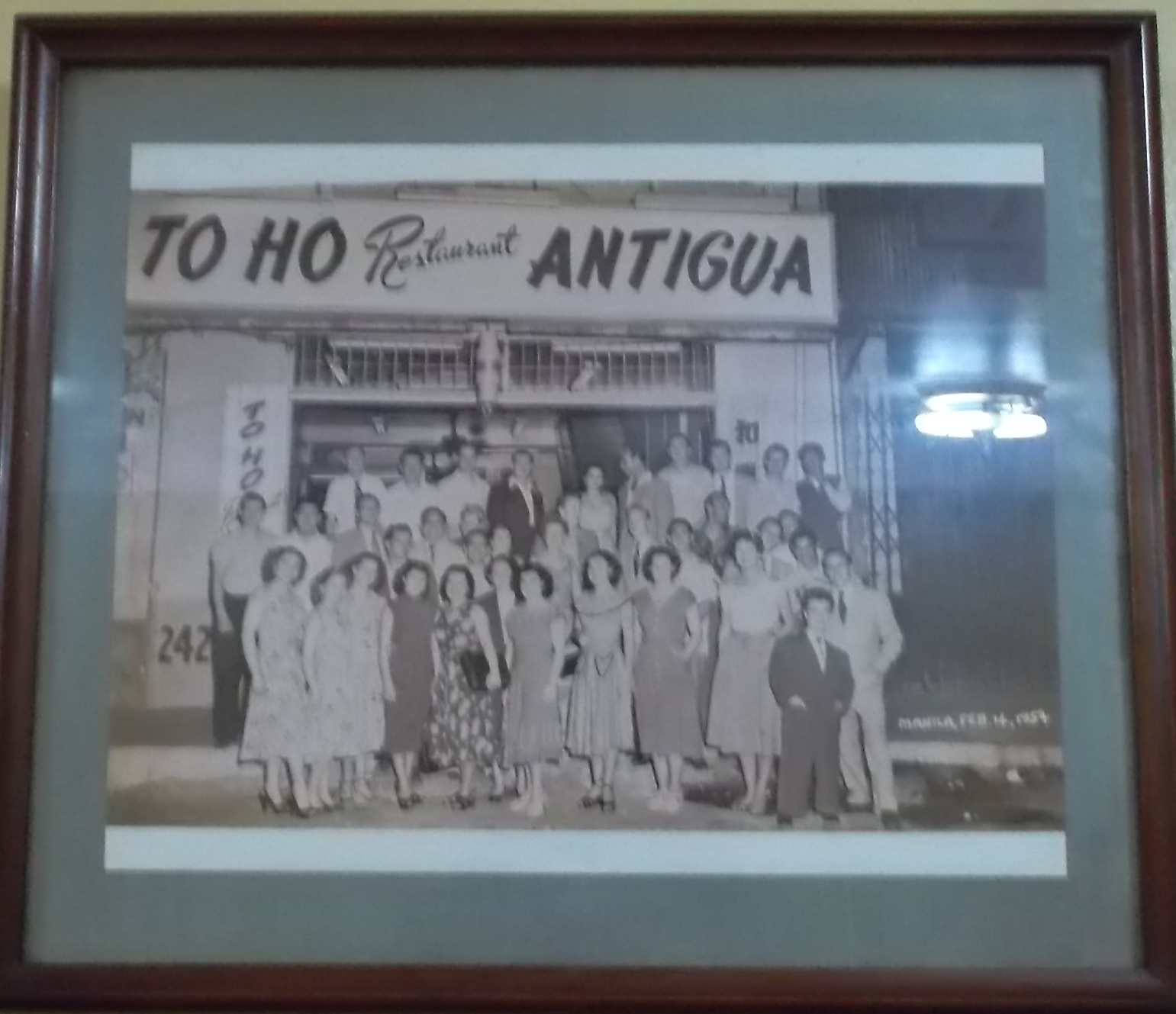
Old photo of Toho Antigua taken in 1954


Getting ready in case diners arrive in droves.

National hero Jose Rizal regularly dined at Toho Antigua Panciteria.


           The owners of Toho should start banking on the popularity of its number one patron, Dr. Jose Rizal, to drum up interest in the old resto.  

           A huge portrait of the national hero near the entrance would be an eye catcher.  

            And spicing up the menu would do wonders. Why not include items such as Padre Damaso's Soup #5?  Or Maria Clara's Sweet Green Peas with Shrimps?  Or Sisa's Nakakabaliw na Asado

             Or ask the guard manning the entrance to wear a Guardia Civil uniform instead of the standard blue and white. The heirs of Tai Tang can use their creativity.


Yang Chow Fried Rice

Beef with Ampalaya

Miki Bihon

Pinsec Frito or Fried Wonton

Camaron Rebosado

           As we were going down the stairs of Toho, several diners were on the way up. While the place apparently lacks the luster of the old Toho, patrons nonetheless keep coming back for the Chinese dishes that had given full satisfaction to diners of the 19th and 20th centuries.  

            And dining at Toho gives others the chance to roam the streets of Chinatown and the nearby Divisoria area. 


After dining at Toho, one can walk through the streets of Binondo.

Tikoy or Chinese rice cake

Assorted fruits for sale

Photo taken several days after the Chinese New Year

A cluster of fruit vendors

One of the many branches of Amo Hopia & Bakery

Cantaloupe or sweet melon

Star apple or kaimito


           I intend to dine again at Toho next month to try the Pata Tim and Asado. And to ride again the iconic calesa. To hear again the sound of the galloping horse. It takes me back to the old days.

Leave your car behind and take the LRT.

- Konted


_____________________________________________________