Showing posts with label quiapo. Show all posts

Friday, 20 November 2020

MA MON LUK


MA MON LUK

Before Henry Sy, Lucio Tan and John Gowengkei, there was MA MON LUK. 

A poor migrant from Canton, China, Ma started walking the streets of Manila in 1918, peddling mami noodles. 

Magiliw, masayahin siya and people liked his noodles. 

Soon, he had outlets on Salazar St. in Binondo, Quezon Blvd. near Quiapo Church and at Quezon Avenue near Banawe in Quezon City.

Ma became rich, super rich.

Today, after 102 years, there is still a legion of diehards willing to brave the rain and endure heavy traffic to have a taste of Ma Mon Luk. 

Ma Mon Luk remains a force to be reckoned with.

KONTED


Whenever this lady buys beads and accessories at Villalobos St. in Quiapo, she makes it a point to have a bowl of Chicken Mami paired with Special Siopao at the Quiapo branch of Ma Mon Luk.


After more than 10 decades, it is still the same broth, the same noodles, the same chicken strips, the same sauce and the same aroma. Nothing has changed.


Ma Mon Luk along Quezon Avenue near Banawe St. in Quezon City. With my dog, I had to wait for a parking slot as the resto was filled to the brim.

Brace yourself for a longer waiting time at Ma Mon Luk in Quezon City


Certified diehards

First on this balikbayan's bucket list:  a bowl of Chicken Mami and Special Siopao


When Ma Mon Luk was peddling Ma Mi noodles, he would cut, with a pair of scissors, the chicken strips. It was termed 'gupit'.

Siopao Asado, Siopao  Bola Bola and Special Siopao

I used to see this wall sign at the Quiapo branch of Ma Mon Luk in my college days. (philstar pic;;caption is mine)


Ma Mon Luk Ma Mi King restaurant on Salazar St.in Binondo in the early years(g-gle pic;caption is mine)

Ma Mon Luk branch in Cubao, Quezon City in the 60s, 70s and 80s when the legal heirs of Ma Mon Luk decided to expand the family business. (D.O.T pic; caption is mine)

Whenever there was a crisis or calamity, Ma would respond by donating sacks of rice. (g'gle pic; caption is mine)

________________________________________


Thursday, 20 February 2014

The Church of Santa Cruz

Old photo of Sta Cruz Church

The Church of Santa Cruz

            Every year, the Black Nazarene of nearby Quiapo Church steals the thunder. Millions join the procession in paying homage to the black statue of Jesus Christ carrying the cross.  And it is beamed live nationwide throughout the day-long procession that starts from the Quirino Grandstand in Luneta and snakes its way through the principal streets of Quiapo district.  Relegated to the background and, seemingly, playing second fiddle is the statue of Nuestra Senora Del Pilar.

The Carriedo Fountain in front of the Church is now one of the main attractions of Plaza Sta Cruz.

The Carriedo Fountain was originally located at the foot of Nagtahan Bridge near Sta Mesa.

The third Welcome Arch of Chinatown.  It stands across Sta Cruz Church.
1961 photo of Plaza Sta Cruz which is in front of Sta. Cruz Church. (Nostalgia Manila photo)

            Nuestra Senora Del Pilar, otherwise known as Our Lady of the Pillar, is housed in an old church locked by two plazas at the district of Santa Cruz in Manila. Sta Cruz Church's original structure was built by the Jesuits in 1608 for the Chinese immigrants who were clustered in a place called Binondo. In front of the Church is Plaza Sta. Cruz while at the rear is Plaza Goiti.  Sta Cruz then was the premier district of the City of Manila.

Sta. Cruz Church today.  It is said that the Church's architecture resembles the churches built by the Spaniards in California.

The bell tower at right enhances the beauty of the Church.

Brick-like tiles were added to the exterior walls of the Church.

Right flank of the Church

About Santa Cruz Church

             Nuestra Senora Del Pilar, like the Black Nazarene, has devotees who frequent the Church to ask favors or divine intercession.  There was even a time when religious veneration or devotion was so intense that a cult was said to have been formed. At the height of her popularity, Nuestra Senora del Pilar was lavishly dressed and had ornaments decorated with gold and diamonds especially during processions.  Drawing attention is an old beautiful water fountain fronting the Church. It is called Carriedo Fountain named after the rich man responsible for installing Manila's water system. One distinguishing feature of Santa Cruz Church is its proximity to Escolta which was then the premier business center of Manila.

Church interior

Closer shot of main altar

Statue of Nuestra Senora del Pilar at right side of  the Church

Saint Peter Julian Eymard is the second patron saint of Sta Cruz Church. The French saint was the founder of the Blessed Sacrament Congregation.

Statue near main entrance

Different statues of the Blessed Virgin Mary.  At right is Nuestra Senora del Pilar with a devotee in deep prayer.

Old crypts inside Sta Cruz Church

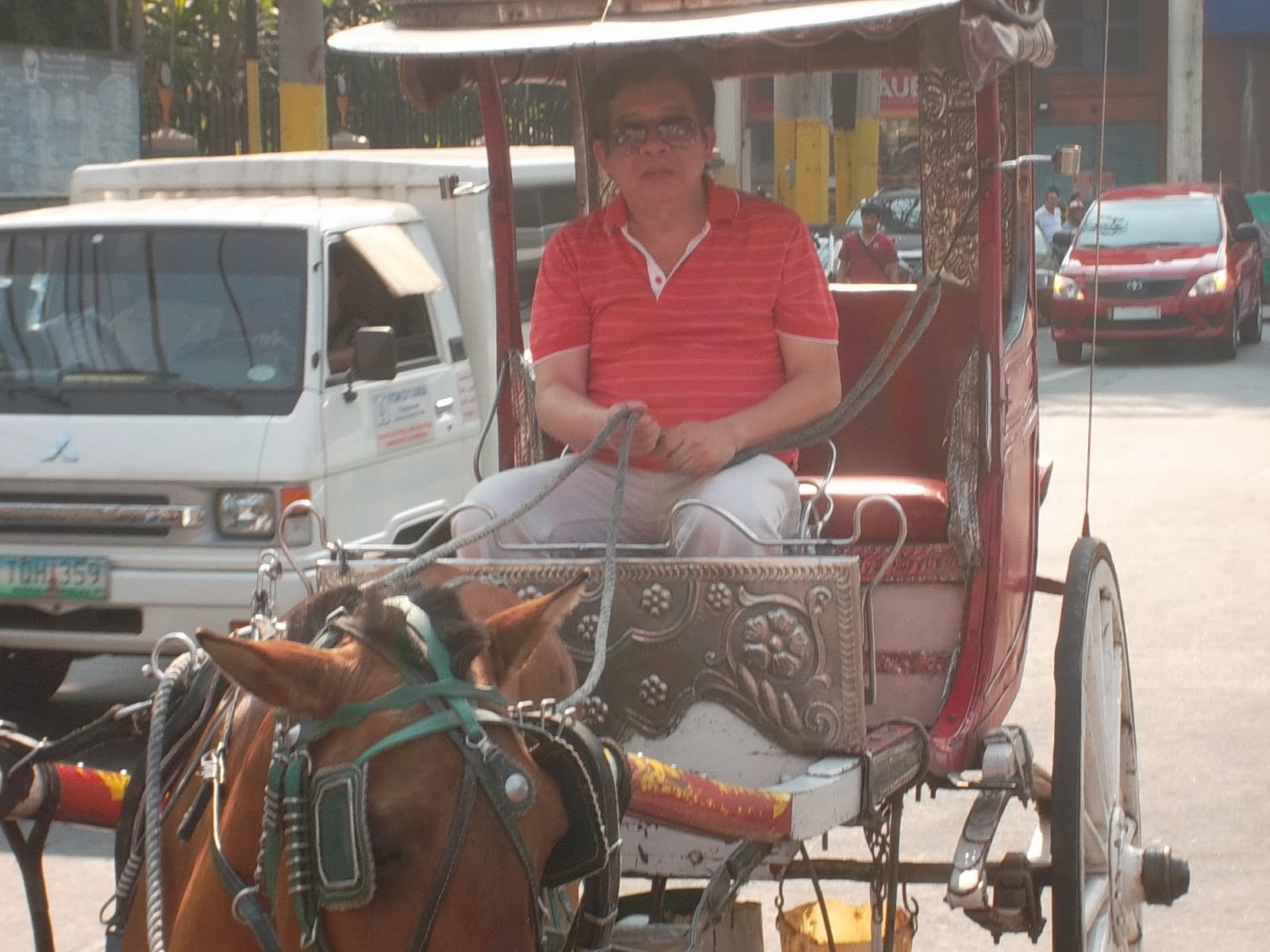
             My favorite rig driver was waiting near the Church. Mang Willie, who hails from San Carlos City in Pangasinan, parked his calesa at the western side.  There was nothing that blocked the view. He made sure we could see him at once. We were holding at the big wheel as we embarked: Idiretso mo diyan sa Dasmarinas.  Hanggang dulo. Tas liko mo sa Escolta. Dahan dahan lang tayo sa Escolta. Tas bahala ka na kung saan tayo.  And then there was that sound I have always wanted to hear: tigitac, tigitac.... I was back to my own little world. Even for a brief moment.

Mang Willie and his calesa wait across the Church.

Taking hold of the horse's reins. Feeling like Ben Hur, not Ben Hur Luy, but Judah Ben Hur as played by Charlton Heston.  (Ha ha)

The ride starts near Dasmarinas Bridge

You pull the left abaca rope if you intend to turn left.  And you pull the right rope to make a right turn.

Another calesa overtakes at Dasmarinas Street.

The old Capitol Theater along Escolta Street

Mid part of Escolta Street

Syvel's Department Store had closed shop many, many years ago.

The old Regina Building.  It was designed by a son of Juan Luna.
Escolta in the old days (g'gle)

Berg was one of several department stores located along Escolta Street. (google)

Konted


_________________________


Thursday, 13 February 2014

Under The Bridge of Quiapo


Under The Bridge of Quiapo

          I do remember a lot of things. From the trivial to the significant. I still remember that guy in the late 60s, in our place in Santa Mesa Heights, who would sing, when everybody and everything around was quiet, a line from a local novelty song:  Me pulis, me pulis sa ilalim ng tulay. Then he would sing the same line again, this time it was longer:  Me pulis, me pulis, me pulis, me pulis sa ilalim ng tulay. That made me think.  Under a bridge is a river or a body of water. Or a ravine. Why would the policeman stay under the bridge?  I was being naive then and I was to find out later that there is really a bridge where a policeman is stationed under it.  And that is Quezon Bridge in Manila.

Puente Colgante bridge was a suspension bridge that preceded Quezon Bridge.

Quezon Bridge.  The steel and other materials used were shipped from England.

         Quezon Bridge is more popularly known as Quiapo Bridge. Or Tulay ng Quiapo.  Replacing an old suspension bridge that connected the Quiapo district to Ermita, Quezon Bridge was built in the 1930s with steel arches forming the structure that crossed the Pasig River. From the north, the ascent to the bridge starts right after Quiapo Church.  From the south, the bridge starts near the Metropolitan Theater. The bridge was named after President Manuel Quezon. The principal road connected to it is also named Quezon Boulevard which leads to the Quezon Memorial Circle in Quezon City. All were named after the Commonwealth President.

Northbound vehicles ascend Quezon Bridge.  The bridge was named after President Quezon.

Approaching Quiapo district

Quiapo Church near Quezon Bridge.  

         As Quiapo is a commercial district, business is conducted almost everywhere including the area under Quiapo Bridge. Vendors, drivers and traffic enforcers refer to that place as " ilalim ng tulay ng Quiapo". Beneath that bridge are stalls selling Philippine handicrafts, from capiz shells to abanico to portamoneda to alkansiyang bungbong.  Name it, they've got it.  While the prices are reasonable, haggling is still part of the game. Items sold here are made of high quality materials. It is very near the famous Simbahan ng Itim na Nazareno.

Philippine handicrafts are sold in stalls under Quiapo Bridge.  

These native products come from various parts of the country.  Items  made of Capiz shells are best sellers.

Items sold under the bridge are made of high quality material.

Assorted items made of abaca and other native products

Stalls are right under the concrete beams of the bridge.

Balikbayans frequent Quiapo Bridge for souvenir items.

Haggling is always part of the game.

Vehicles making a u turn take the road under the bridge.

         I was there last week. While passing under the bridge, I saw a policeman covering his beat. He was young and seemed to be newly-hired. As I took the bend, I saw two other policemen exchanging notes. When I made it to the other side, I saw more policemen. Then a few meters away was a police station. With a situation like this, expect no snatching, no pick pocketing, no hold up. It is safe to say, then, that it is no longer dangerous walking within the vicinity of Quiapo Church.  It is all because "me pulis sa ilalim ng tulay." 

Konted

Wrist watches for only P50

Belts for P20

Sliced watermelons 

Some vendors are confined in an area near Carriedo in  front of Quiapo Church near Plaza Miranda.

Massage oil good for "ubo, sipon, lagnat, etc."

Medicinal herbs sold near the church

For adults only.  Sex gadgets for sale.  

Green mangoes sell for P50 per bunch.

Globe's Special Lumpia

Several officers and men of Police Station 3 in Quiapo
____________________________________