The Old Binondo Church
History tells us that Ferdinand Magellan and his men discovered the Philippines on March 16, 1521. The might of the conquistadores was represented by a sword and a cross. Their two-fold mission, in the name of the King of Spain, was to colonize the entire archipelago and, at the same time, spread Christianity. Miguel Lopez de Legaspi, for his part, conquered and occupied Manila and, like in the other islands, started establishing Christian communities. The first step was to convert the inhabitants.
At that time, there were many Chinese immigrants doing business in Intramuros and staying in a community called Binondo. These immigrants were called Sangleys. They were allowed to stay there by Spanish authorities as a way of controlling and monitoring the growing number of Chinese. These early ethnic Chinese intermarried with the local women and from this union, the Chinese mestizo or mestizo de Sangley was born.
As the Spanish friars wanted to ensure that these Sangleys and their offsprings would continue practicing their new faith, a church was constructed in Binondo in 1596. It was called Binondo Church. Initially made of adobe stones, it had undergone several renovations and rehabilitations ever since.
Binondo Church is now called Minor Basilica of Saint Lorenzo Ruiz. It was named after the first Filipino saint who was a resident of Binondo and had his training at the church. It stands on a big lot bounded by Quintin Paredes St, Ongpin St. and Condesa street. There is a big plaza in front of the church. It is called Plaza Calderon De La Barca.
The ceiling of the church is painted with religious images in the same way that Sistine chapel in Italy is artistically painted. The windowpanes are also beautifully painted. Many weddings are solemnized in this historical church. It is near Escolta, near the commercial streets of Chinatown, near Divisoria.
The church represents Binondo's glorious past. With the century old bell tower still standing proud, the bell rings at dusk as the faithful give thanks to the Almighty for a prolific day. At early morning of the next day, the doors of the church are opened again for devotees who seek divine guidance. Candles are lit and prayers are said. They then dip their two fingers into the holy water and make the sign of the cross, feeling confident that God will answer their prayers.
- Konted
 |
| The Filipino-Chinese Friendship Arch stands on Quintin Paredes St. which is several meters away from Binondo Church. |
.JPG) |
| Binondo Church is now known as Minor Basilica de San Lorenzo Ruiz. |
.JPG) |
| San Lorenzo Ruiz was a Binondo resident and was active in church activities. |
.JPG) |
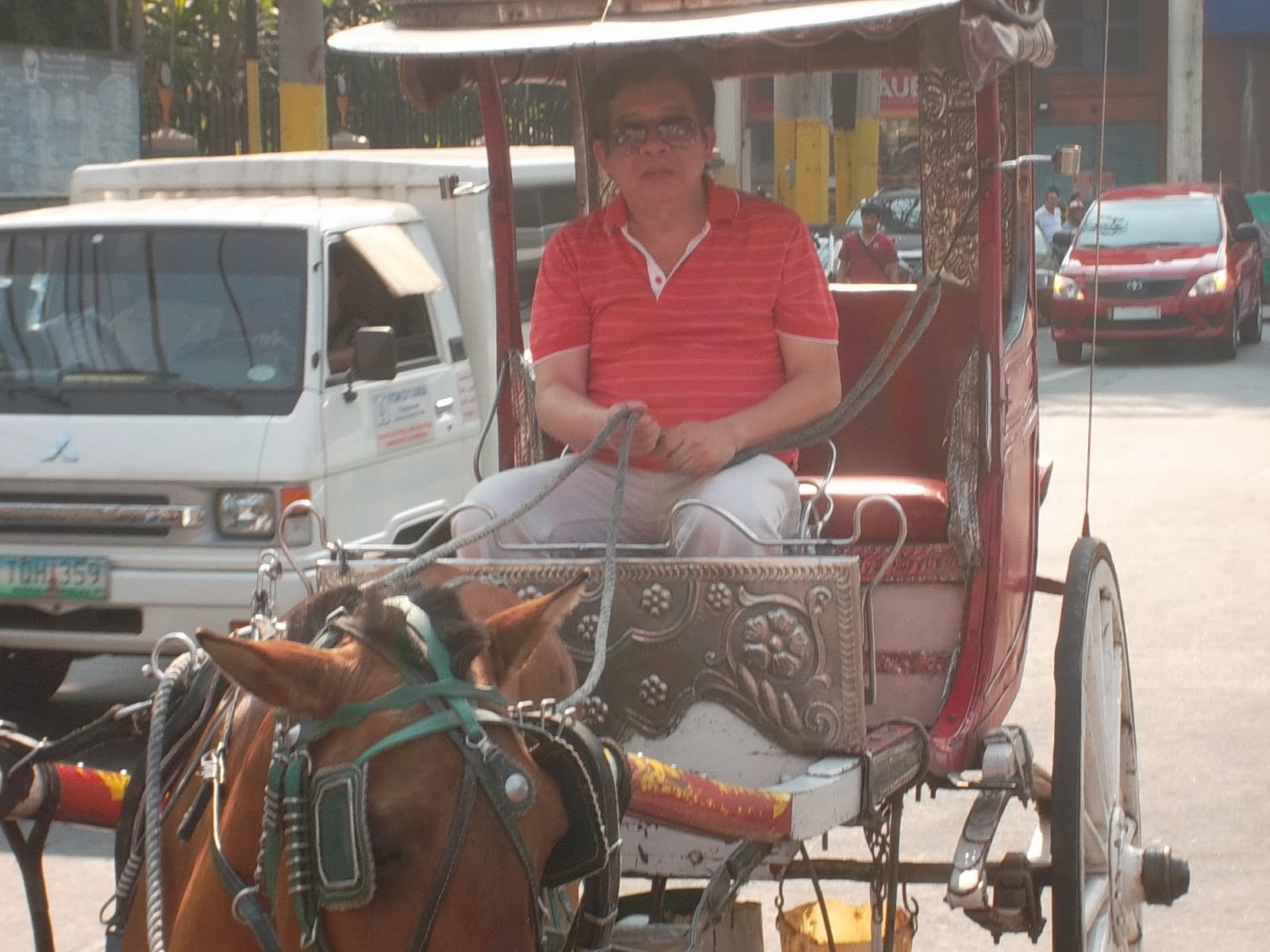
| The old calesa or horse-drawn carriage is still a mode of transportation in Binondo. Waiting area is across Binondo Church. |
.JPG) |
| The Cochero says: "Boss, mas maganda nakasakay kayo dito at iikot tayo Chinatown. " Manila's Chinatown is the oldest Chinatown in the whole world. |
.JPG) |
| P200 per ride around Chinatown for 3 passengers. It is still negotiable. |
.JPG) |
| Traffic enforcers control the flow of traffic in front of Binondo Church. The plaza in front of the church serves as a roundabout or rotunda. |
.JPG) |
| Plaza Calderon de la Barca is right across Binondo Church. Shown above is the statue of San Lorenzo Ruiz. |
.JPG) |
| Monument to WWII Chinese veterans |
.JPG) |
| Jeepney waits for passengers in front of the plaza. |
.JPG) |
| Binondo Church was destroyed during WWII. Only the bell tower was spared. |
.JPG) |
| View of Binondo Church from Ongpin St. |
.JPG) |
| Area along Ongpin St. where calesas wait for passengers. |
.JPG) |
| Statue of Roman Ongpin after whom Ongpin St. was named. It is on the left side of the church. |
.JPG) |
| About Roman Ongpin |
.JPG) |
| Inner main door of Binondo Church |
.JPG) |
| The Crucified Christ near the entrance. |
.JPG) |
| Area where devotees light candles |
.JPG) |
| Church's interior |
.JPG) |
| Hand painted ceiling of Binondo Church |
.JPG) |
| The main altar |
.JPG) |
| Statue of San Lorenzo Ruiz near the main altar |
.JPG) |
| Interior of Binondo Church as taken from the main altar |
.JPG) |
| Beautifully painted glass windows |
.JPG) |
| Statue of the Sacred Heart near the center aisle |
.JPG) |
| The suffering and crucifixion of Jesus Christ as painted on the ceiling. |
.JPG) |
| Donations help a lot in the maintenance of the church. |
.JPG) |
| Statues of three saints at the left wing of the church. |
.JPG) |
| Station of the Cross |
.JPG) |
| Statue of the founder of Opus Dei |
.JPG) |
| Artistically designed glass window |
.JPG) |
| Statue of St Anthony |
.JPG) |
| The glass casket of Jesus Christ |
.JPG) |
| Upper right ceiling |
.JPG) |
| Church balcony |
.JPG) |
| Coins for the street children |
.JPG) |
| Saying a short prayer |
.JPG) |
| In deep prayer |
.JPG) |
| A variety of colors |
.JPG) |
| Rosaries for keeping count while praying |
.JPG) |
| Small religious statues usually placed on top of tables or altars. |
.JPG) |
| The Pasig River separates Intramuros from Binondo. |


.JPG)
.JPG)




.jpg)


.JPG)
.JPG)
.JPG)
.JPG)
.JPG)
.JPG)
.JPG)
.JPG)
.JPG)
.JPG)
.JPG)
.JPG)
.JPG)
.JPG)
.JPG)
.JPG)
.JPG)
.JPG)
.JPG)
.JPG)
.JPG)
.JPG)
.JPG)
.JPG)
.JPG)
.JPG)
.JPG)
.JPG)
.JPG)
.JPG)
.JPG)
.JPG)
.JPG)
.JPG)
.JPG)
.JPG)
.JPG)
.JPG)
.JPG)
.JPG)
.JPG)